
Giving a Gift? Don’t Make These Mistakes
While ideally we all go through life without expectations and anything like a present or gift is just a bonus, that’s not realistic. The etiquette of gift-giving can be a tricky business to navigate. There will inevitably come a time when you should be able to pick out something nice for another human being. Unlike my husband, you may not always have a partner who can go do it for you.
Some gift-giving “rules” don’t always hold true, and if just the idea of trying to come up with the “perfect gift” makes you just think you’ll head to the gift card section by the cash register, slow down. Use some thought and imagination to think about your recipient.
After aimlessly browsing Amazon or wandering the aisles of a store, you may throw up your hands and say “eh, I’m not good at this- just get them a gift card.” And some recipients may be perfectly happy with a card. But consider the percentage of recipients who may not actually use that gift card. In 2021, it was estimated that Americans are sitting on $15 billion in unused gift cards and credit. Yes. Over half of U.S. adults have unused gift cards, vouchers, or store credit they have not used. I’m one of them and while I can’t remember all the gift cards I never used, I can easily think of at least a few hundred dollars’ worth of cards for a merchant that went out of business, or that were lost or stolen.
Don’t let your recipient be another statistic or treat them like one. It’s not hard to take a few minutes out of your day and do a little research and planning for someone else.
Let’s start with some common misconceptions and “rules” that don’t always actually apply when choosing a gift.
"The Gift Has to be a Physical Item."
Most gifts that are exchanged are a physical item you can hold in your hands. Less common (but often far better received) is the gift of an experience, or the gift of time. Tickets to an event or a destination won’t immediately be consumed by the recipient but the experience could be something they will remember long after a physical item is discarded and forgotten.

As an example- I remember a pair of tickets to a U2 concert I attended shortly after 9/11 that I was gifted by a friend. He hemming around the entire time and apologizing “just in case” I didn’t really want to go.
This friend knows I like U2 yet this misconception that a thoughtful gift must be physical persists, and he even felt that he had to follow up the tickets with a DVD box set just in case I didn’t like the concert.
The day of the concert I will always remember. The names of the victims of that tragedy were projected across the faces of everyone in the stadium and it was one of the most powerful concerts I’ve ever attended. The DVDs? They are somewhere in a box in storage, but the memories are with me every time I hear those songs.
"The Gift Should Be Immediately Enjoyed/Consumed."
A gift that is used/experienced right away often elicits an immediate response, and the giver also enjoys the exchange. When you can’t always think of or find something good, the right kind of edible gift might be a nice gesture.
But consider this- sometimes a gift that isn’t immediately used may give more long-term enjoyment. A package of your recipient’s favorite tulip bulbs may not look as sexy as a bouquet of fresh ones in a vase-- but a savvy gardener will enjoy them year after year and remember your thoughtfulness each spring.
A partial gift under the right circumstances (where you know that’s what they want) may also be welcome. Perhaps the recipient wants something big that most people would not typically give as a gift, such as a new computer or a car. You may not be able to give them the keys to a new car or donate a college fund, but can instead contribute towards the larger goal and get the recipient one step closer.
"The Gift Must Be a Surprise."
If your recipient has a registry, a gift/wish list, or has even expressed explicitly what they want for their birthday or another occasion where a gift exchange is planned, it’s not wrong to give them something they may not be surprised by. While the idea of an unrequested gift that you took the time to think about and track down might be exciting to you, they may ultimately favor a gift they know they want more. And if you really just want to surprise them, find a little small add-on you can include with the main gift.
That’s not to say a surprise is always a bad idea. Sometimes a “just because” gift that is also a surprise is a welcome one, but always consider your audience and if in doubt, keep it low key.
I remember the day I got a travel itinerary to Paris as a gift from a loved one. It was known that this was on my “bucket list.” And it was gifted in a way (an itinerary that was reserved months out, and not set in stone) that allowed me to plan and allowed some flexibility. Almost as memorable was the time I received a surprise gift of a very expensive coffee maker from an in-law who was more excited about it than I was. I don’t like coffee. It was definitely a surprise. There I was in front of the whole extended family, with one obnoxious aunt who felt the need to point out that “But I thought you didn’t like coffee,” and kept going… even as her husband squeezed her hand. Awkward!
"The Gift Should Be a High Dollar/Highly Desirable Item."
The gift giver will know exactly how much the gift was, but the recipient may not fully grasp the value of their gift, and in most cases, the value is not the most important thing to the recipient. I have actually watched the awkward charade where the recipient didn’t look quite as excited as the value of the gift might have warranted. Finally, the gift giver felt the need after a few minutes of watching the recipient examine the gift to point out how much it cost. And then of course everyone in the room got excited. Except the recipient of the gift of course, who felt increasingly worse.
Ask yourself- are you buying this to delight the recipient or are you setting out to impress them and make yourself feel better? Is it genuinely something they will enjoy because it is valuable or because it has personal value?
I feel that I should point out the obvious, that even though some of us might find it a little crass, younger people often do place a higher emphasis on the brand or the cost of an item than older generations. To many of them, the price tag or the brand name is the personal value. Before you splash out too much, be sure you have thought through the importance of the price when choosing an expensive gift.
"The Gift Should be Enjoyable for the Giver to Give."
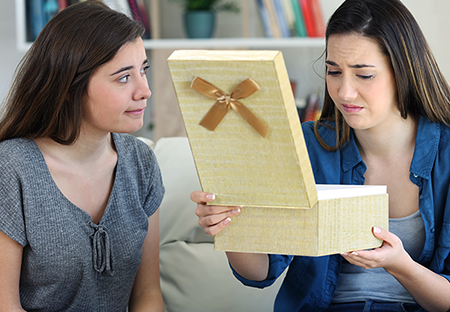
Don’t make it about you. The gift should reflect the recipient, not something that you’d like to have yourself. While it may make you look good to give your recipient something that makes you look smart, responsible, and clever, if it doesn’t reflect the personal interests of the recipient, it’s not a thoughtful gift.


